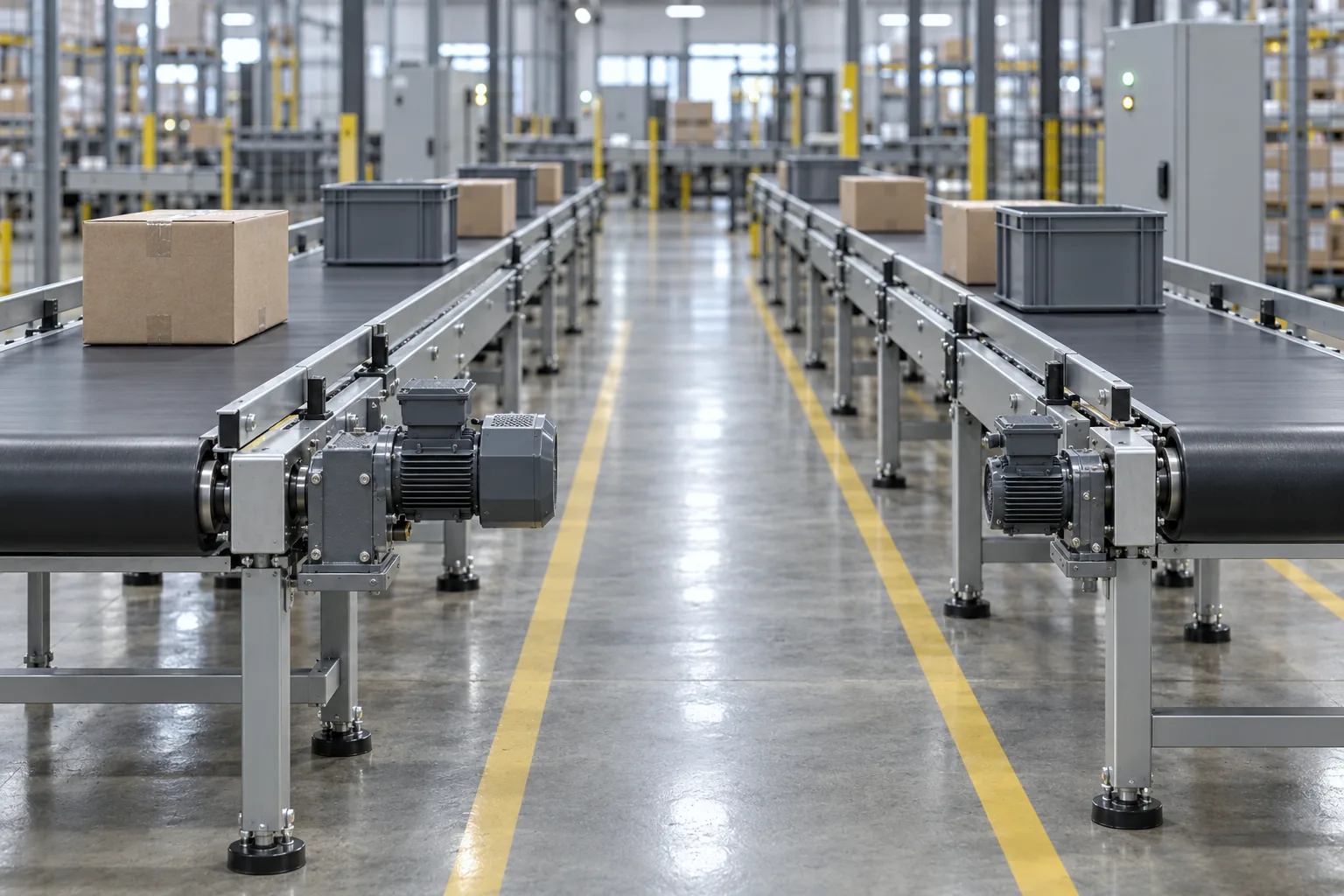
A conveyor control system decides when each conveyor runs, how fast it runs, and what happens when something goes wrong. Done well, product flows smoothly from infeed to outfeed, jams are caught early and anyone can stop the line safely. Done badly, product piles up at transfers, motors trip on start-up and the conveyors become the weakest link in the line.
This guide explains the main building blocks, and what to think about when you specify a new system or upgrade an old one.
What a conveyor control system does
- Starts and stops conveyors in the right order
- Controls motor speed and keeps conveyors in step with each other
- Holds product in zones so it can queue without pressure
- Detects jams, blockages and belt problems
- Connects emergency stops and guards to the safety system
- Exchanges signals with the machines it serves, such as fillers, scanners, palletisers and shredders
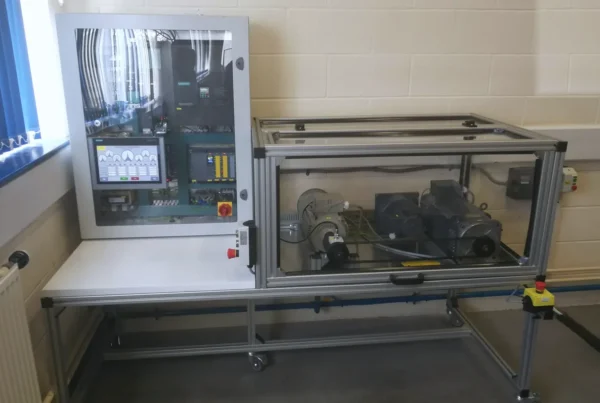
Industrial systems often use a PLC, with motor starters or variable speed drives in the control panel and an HMI for operators.
Drives: direct-on-line, soft starter or VSD
| Motor control | Best for | Watch out for |
|---|---|---|
| Direct-on-line starter | Small, fixed-speed conveyors | High starting current and abrupt torque application; use the motor manufacturer’s starting data when sizing the supply and protection |
| Soft starter | Larger fixed-speed conveyors | No speed control once running |
| Variable speed drive (VSD) | Conveyors that need speed control, gentle starts or speed matching | Correct sizing, cooling space in the panel and attention to EMC |
A correctly selected and configured VSD can ramp the conveyor up gradually, reducing abrupt mechanical loading and helping control belt slip. It also lets speed follow the processes upstream and downstream. Matching speed to demand can also save energy. The gearbox and motor still have to suit the duty: the drive controls speed, but the torque at the conveyor depends on choosing the right gearmotor.
Conveyor control system start and stop sequences
On a line of several conveyors, the usual rule is to start from the outfeed and work back towards the infeed, so each conveyor has somewhere to send product before the one behind it starts. Stopping normally runs the other way, from the infeed, so conveyors can clear before those downstream stop.
Where the process permits, starts can be staggered to avoid simultaneous motor starts; the interval must suit the load, acceleration time and product flow. Before releasing product, confirm that the receiving conveyor is available using the feedback appropriate to the process. A drive-run status does not necessarily prove belt movement; independent speed or product-movement feedback may be needed. If a downstream conveyor stops, prevent further discharge into the blocked transfer. Upstream buffer zones may continue filling where the agreed accumulation logic allows.
Zone control and accumulation
Where product needs to queue, for example ahead of a labeller or palletiser, the conveyor is split into zones, each with its own sensor. In zero pressure accumulation, zone controls coordinate release using downstream availability, helping products queue without sustained contact pressure. The detailed release logic depends on the conveyor and operating mode. That means less product damage and tighter control over how product arrives at the next machine.
Many accumulation conveyors now use 24 V motor-driven rollers, with each zone driven separately. The zone logic can run on the conveyor itself or in the PLC; the choice depends on the conveyor controller, required diagnostics, integration interfaces and support arrangements.
Detecting jams and belt problems
- Jam detection: sensors time how long product takes to move between points; if it is late, the conveyor stops and raises an alarm.
- Speed monitoring: a speed sensor on a non-driven pulley shows belt slip or a stalled conveyor that the motor alone will not reveal.
- Belt misalignment switches: selected and positioned for the conveyor; a two-stage arrangement can provide a warning followed by a stop as drift increases.
- Blocked chute detection at transfer points on bulk handling conveyors.
- Drive diagnostics: current, fault codes and running hours read over the network help find problems before they become breakdowns.
Safety devices
Stopping a conveyor is not the same as isolating it. Clearing a jam or working near hazardous movement requires the site’s approved safe system of work, including secure isolation and control of stored energy where required. Do not bypass guards or interlocks to keep production moving.
Conveyors are long, with many nip and trapping points, so stopping them quickly matters.
- Emergency stops and pull-cord switches positioned according to the risk assessment and conveyor layout. Pull-cord systems need suitable coverage, installation and checking; they supplement guarding and isolation rather than replacing them.
- Guards and interlocked access at drives, transfer points and pinch points.
- A proper safety circuit. The complete safety function—including input devices, safety relay or safety PLC, and final switching or drive elements—must be designed and validated to the required performance level or safety integrity level identified by the safety assessment. A safety-rated controller alone does not establish that the function meets its target.
- No automatic restart. After an emergency stop, the line should need a deliberate reset and a separate start.
When a line is extended or speeded up, check that the safety functions still match the risk. Users of machinery remain responsible under PUWER for keeping it safe after any change.
Specifying a conveyor control system
A clear brief saves time at every later stage. It should cover:
- a layout showing every conveyor, transfer, merge and divert
- product types, sizes, weights and rates, and where product must queue
- which conveyors need speed control and which can run at fixed speed
- the machines the conveyors connect to, and the signals they exchange
- emergency stop zones, and how much of the line each stop should halt
- the environment: washdown, dust, temperature, outdoor sections
- what operators need: HMI screens, alarms, and risk-assessed recovery modes, with secure isolation where required for blockage clearance
- the data you want: running hours, stoppages and throughput
Planning a conveyor control system upgrade
We design and build control systems for conveyors and materials handling, from a single line to complete systems: PLC software, drive and motor control panels, HMIs and implementation of approved safety functions. Factory checks cover the agreed workshop scope; final integration, site testing and safety validation must address the installed system. We can also upgrade the controls on conveyors you already run, rather than replacing them.
As part of Advanced Engineering Group, we can bring in the gearboxes too, through our sister company Advanced Drives, so the motion and the control come from one group and one point of contact.
Find out more about our work in conveyors and materials handling, or talk to us about your line.
Frequently asked questions
What is a conveyor control system?
The PLC, drives, sensors and safety devices that decide when each conveyor runs, how fast it runs and how it stops, to coordinate product flow and manage defined faults and stoppages.
Which conveyor should start first?
Normally the one at the outfeed, working back towards the infeed, so each conveyor has somewhere to send product. Any start delay should be chosen for the actual conveyor and process.
What is zero pressure accumulation?
A way of queuing product in zones, each with its own sensor, so products can queue with controlled separation and without sustained contact pressure. Release is coordinated with downstream availability and the configured operating mode.
Do conveyors need variable speed drives?
Not always. Small fixed-speed conveyors can run on direct-on-line or soft starters. Variable speed drives suit conveyors that need speed control, gentle starts or speed matching with other machines.
What safety devices does a conveyor need?
It depends on the risk assessment, but typically emergency stops at operator positions, pull-cord switches along the conveyor, guarding at drives and transfer points, and a deliberate reset before restarting.
Sources and further reading
- ABB Softstarter Handbook
- HSE machinery safety and isolation
- Interroll: ZoneControl and distributed accumulation control
Sources checked 28 October 2026. Confirm current component availability, standards and legal requirements for your project.